I consider SMP appropriate for scarring alopecia only after a dermatologist confirms the condition has been inactive, usually for at least twelve months. I use pigment to camouflage scarred areas, not regrow hair. Treatment is planned over three sessions, with healing between visits, and results generally last four to eight years before touch-up.
You’ve been told the bald patches from your scarring alopecia are permanent, and you’re now researching what can actually be done about the way it looks. This article explains exactly when scalp micropigmentation is appropriate for cicatricial alopecia, what has to happen before you’re a candidate, and what the healed result really looks like. By the end, you’ll know whether it’s worth booking a consultation.
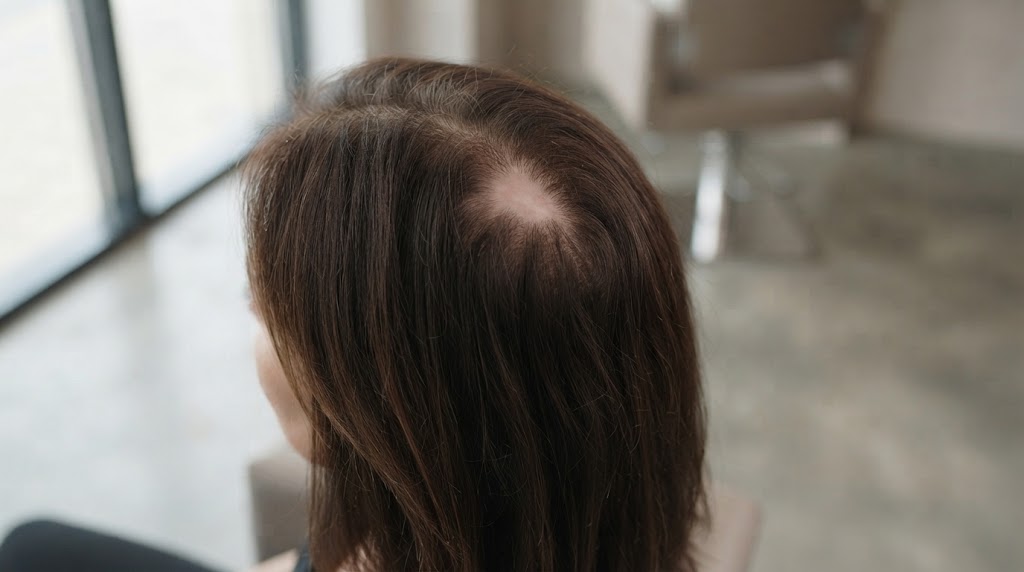
SMP for scarring alopecia works by depositing pigment into the affected skin to recreate the visual texture of a shaved head or add density between existing hair, camouflaging the contrast between scar tissue and surrounding scalp. It does not treat the alopecia itself, and it never regrows hair. Having worked with clients across every stage of cicatricial alopecia over 42 years in this industry, I’ve found the single biggest factor in a good outcome is timing, not technique.
1. The condition has to be inactive before anyone touches a needle to your scalp
Cicatricial, or scarring, alopecia includes conditions such as lichen planopilaris, frontal fibrosing alopecia and discoid lupus erythematosus, all of which destroy the hair follicle permanently and replace it with scar tissue. While the condition is active, inflammation is still spreading and the pattern of hair loss is still changing shape.
Treating an active area is a mistake for two reasons. Pigment placed into inflamed skin heals unpredictably, and any progression after treatment leaves you with pigment in the wrong place, mismatched against newly bald skin. Stability first, cosmetic work second, always in that order.
2. A dermatologist’s sign-off matters before any consultation booking does
Before proceeding with a client presenting scarring alopecia, we need written confirmation from a dermatologist that the condition has been inactive for a meaningful period, usually a minimum of twelve months with no new lesions or spreading. This isn’t a formality. It’s the difference between a result that lasts and one that needs correcting within a year.
If you haven’t had that conversation with a dermatologist yet, that’s your genuine first step, not a consultation with an SMP practitioner. Clients researching SMP in Perth or elsewhere should expect this question raised early, not skipped.
3. Scarred skin behaves differently under the needle than healthy scalp
Scar tissue has a different density, texture and blood supply to normal scalp skin. It often takes pigment less predictably, sometimes absorbing more in one pass, sometimes resisting it. A practitioner working on cicatricial alopecia needs to adjust needle depth and dot density specifically for scarred zones versus the surrounding healthy scalp, rather than treating the whole area identically.
This calls for a different skill set to standard density work on unshaved hair or classic pattern baldness. Anyone booking should ask directly how much experience the practitioner has specifically with scarring alopecia and cicatricial tissue, not hair loss in general.
4. Lichen planopilaris scars need a longer stability window before treatment
Lichen planopilaris is a particularly active inflammatory condition, and it’s known for smouldering: appearing dormant, then flaring again months later. For SMP on lichen planopilaris scars, I generally want to see a longer track record of stability than I would for a more static scarring condition, confirmed by a dermatologist rather than assumed from appearance alone.
Clients sometimes feel frustrated by this caution, especially after years of visible hair loss. But treating too early on lichen planopilaris risks pigment sitting in skin that later changes shape again, undermining the exact result you’re paying for.
5. It always takes 3 sessions, regardless of how much of the scalp is affected
Whether the scarring covers a small patch or a broad area, I plan for 3 sessions with every client. The first session establishes the base layer of pigment at a lower dot density, the second builds towards the depth and pattern that reads as natural density, and the third refines tone, blends any remaining transition zones between scar and healthy scalp, and corrects any uneven pigment uptake from the earlier sessions.
Sessions are spaced several weeks apart to let the skin heal fully between visits. Trying to compress this into fewer sessions produces a flatter, less convincing result, particularly on scarred skin where pigment uptake is already less consistent.
6. Healing follows the same timeline as standard SMP, but scarred areas need closer attention
The healing rules are consistent regardless of why you’re having SMP done. For the first four days, no water on the scalp, no shampoo, no sweating and no shaving. From day five to day ten, gentle washing is fine, but keep the scalp out of direct sun. From day ten onward, SPF becomes part of your daily routine and normal grooming can resume, though swimming pools are off limits for a full 28 days.
On scarred skin specifically, I ask clients to watch more closely for irritation during the healing window, simply because scar tissue can respond less predictably than healthy skin. Full healing, meaning the pigment has settled into its final tone, takes around 30 days.
7. Results last years, but scarred pigment can fade slightly faster in some cases
Most SMP clients see results hold for four to eight years before a touch-up is needed, and I generally recommend planning for a touch-up every four to six years as standard maintenance. On scarred tissue specifically, fading can be somewhat less even than on healthy scalp, because scar tissue has different blood supply and cell turnover to surrounding skin.
This isn’t a reason to avoid treatment. It’s a reason to choose a practitioner who checks in on healed results and adjusts touch-up timing to the individual, rather than applying a blanket schedule regardless of skin type.
If you’re dealing with scarring from a hair transplant procedure rather than a diagnosed alopecia, the considerations are different again, and it’s worth reading about how SMP handles surgical and injury scars specifically. For a broader look at how SMP applies across different types of hair loss, the alopecia guide covers pattern baldness, alopecia areata and diffuse thinning in more detail.
Scarring alopecia is permanent, but the way it looks doesn’t have to stay the same. Once a dermatologist confirms your condition is stable, a consultation is the right next step to find out exactly what your scalp will need and what a realistic result looks like for you. Foli Sim offers a free, no-obligation consultation to talk through your specific pattern of scarring, confirm candidacy, and map out what 3 sessions would involve for your scalp.
Frequently Asked Questions
Can scalp micropigmentation be done on active scarring alopecia?
No. SMP should only be carried out once a dermatologist confirms the scarring alopecia is stable and inactive, usually after a minimum of twelve months without new lesions. Treating active alopecia risks unpredictable healing and pigment ending up in the wrong place as the condition continues to change.
Does SMP regrow hair on scarred bald patches?
No. SMP creates the visual impression of density or a shaved look by depositing pigment into the skin. It doesn’t affect hair follicles, doesn’t regrow hair, and doesn’t treat the underlying cause of cicatricial alopecia in any way.
How many sessions does SMP for scarring alopecia require?
Foli Sim always plans for 3 sessions, regardless of how much of the scalp is affected by scarring. Each session builds on the last, adding pigment density and refining tone and blending, with several weeks between sessions to allow full healing.
Is lichen planopilaris treated differently to other scarring alopecias with SMP?
Yes. Lichen planopilaris can flare after periods of apparent calm, so a longer confirmed stability window is generally required before treatment, verified by a dermatologist rather than assumed from how the scalp currently looks.
How long do SMP results last on scarred scalp tissue?
Results typically last four to eight years, similar to standard SMP, though scarred tissue can fade slightly less evenly due to differences in blood supply and cell turnover. A touch-up every four to six years is a realistic expectation.
Ready to talk it through?
Foli Sim in Perth offers a personal consultation to answer your questions and recommend the right approach for you. Get in touch with Foli Sim to book your consultation.