
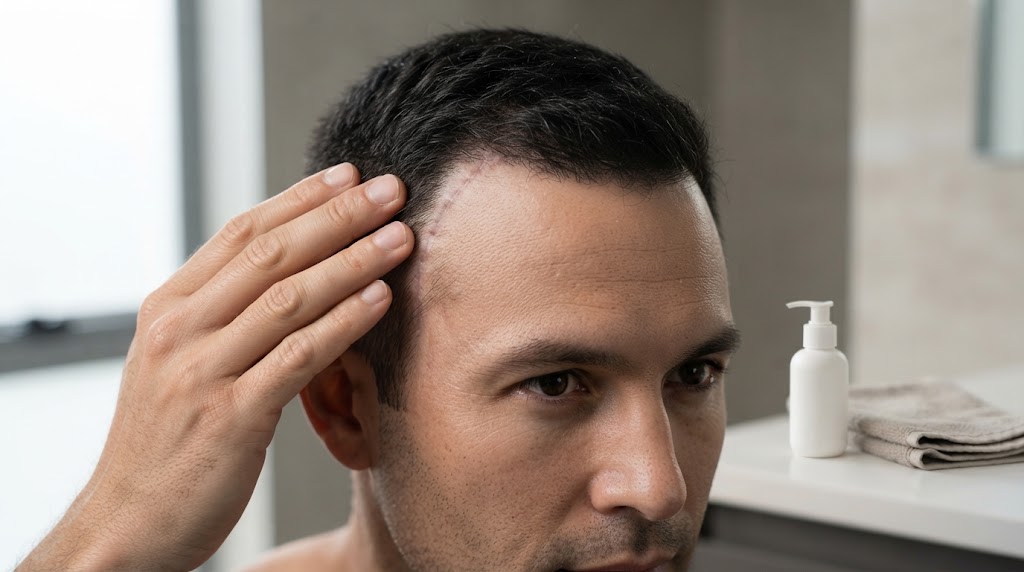
Staring at a linear scar from a scalp reduction, brow lift or old neurosurgery, and wondering if anything can actually make it less visible? You’ve probably already tried concealer powders or grown your hair longer, and you want to know whether scalp micropigmentation is a genuine fix or just another disappointment. Here’s what really happens when pigment goes into scar tissue, and what result you can honestly expect.
SMP for a scalp reduction scar works by matching pigment density in the scar to the density of the hair around it, so the eye no longer catches a bright, smooth line cutting through your hairline or crown. It’s not a miracle eraser. It’s a camouflage technique, and a well-executed one can take a scar from the first thing people notice to something they’d never spot unless you pointed it out.
1. Scar tissue behaves differently to normal scalp skin
Scarred skin has a different structure to the scalp around it. It’s often less vascular, sometimes thinner or shinier, and can hold pigment unevenly compared with healthy tissue.
Kate Dawes, Foli Sim’s Founding Director and Senior Practitioner with 42 years in the hair industry, treats the scar and its surrounding zone as two related but distinct areas. Pigment is applied more conservatively over the scar itself in early passes, then built up gradually, because scar tissue can take colour differently to the skin either side of it, and overcorrecting early is far harder to undo than adding more later.
2. Three sessions are needed, not fewer
Foli Sim always plans three sessions for scar camouflage work, regardless of how faint or prominent the scar looks at consultation. This isn’t a sales figure; it’s how pigment density is safely layered into compromised tissue.
The first session establishes a light base and tests how the scar itself takes pigment. The second builds density across the scar and blends it into the surrounding hair pattern. The third session refines tone, corrects any patchiness and fine-tunes the transition zone so there’s no visible edge where scar meets scalp.
3. A mature scar won’t vanish, and you should expect a realistic result
This is where honesty matters more than optimism. A scalp reduction scar that’s years old, wide or slightly raised will show meaningful improvement with SMP, not total invisibility.
Kate Dawes is direct with clients on this point during consultation: the goal is contrast reduction, not erasure. A scar that previously read as a bright, obvious stripe against surrounding hair can become something that blends convincingly at conversational distance and under normal lighting. Close up, in a bright bathroom mirror, you may still be able to find it if you go looking. That’s a realistic outcome, and it’s the one worth planning for rather than chasing a result SMP was never designed to deliver.
4. Brow lift and cosmetic surgery scars need a different approach to hairline scars
A scar from a brow lift sits in a different context to one from a scalp reduction. It’s often finer, closer to the hairline edge, and surrounded by lower-density hair that’s easier to disrupt visually if pigment placement is off.
For these scars, the practitioner works in smaller, more precise dot clusters rather than broad density fields, matching the finer hair pattern typical of that zone. The aim is always a soft, natural hairline transition, never a hard or sharply defined edge, because that reads as unnatural against real hair growth patterns.
5. Density is matched into the scar from the hair around it, not applied uniformly
One of the most common mistakes in scar camouflage is treating the scar as an isolated patch and pigmenting it at one flat density. That creates a new visible shape, just a different one to the scar itself.
Foli Sim’s approach maps the density gradient of the surrounding scalp first, then feathers pigment into the scar to match that gradient exactly. If hair density fades gradually from thick to thin moving back from the hairline, the pigment inside the scar needs to follow that same fade, not sit as a uniform block.
6. Healing on scar tissue follows the same timeline, but needs closer attention
The healing schedule for scar camouflage mirrors standard SMP aftercare. Days 1 to 4 mean no water on the scalp, no shampoo, no sweating and no shaving. Days 5 to 10 allow gentle washing but no sun exposure. From day 10 you can reintroduce SPF and normal grooming, avoiding swimming pools for 28 days, with full healing at the 30-day mark.
Scarred skin can occasionally take slightly longer to settle in colour during the healing phase, since it processes pigment differently as it turns over. This is exactly why the second and third sessions matter: they let the practitioner see how the scar has truly settled before making final density adjustments.
7. Touch-ups protect the result over time, and scars are no exception
Results from SMP typically last 4 to 8 years before fading enough to need a touch-up, and scar work follows the same pattern. A touch-up every 4 to 6 years keeps density consistent and stops the scar from gradually re-emerging as the surrounding pigment softens with sun exposure and natural skin turnover.
SPF on the scalp from day 10 onwards is one of the simplest ways to slow that fading, particularly over scar tissue, which can be more prone to colour shift than surrounding skin. If you’re weighing this against a hair transplant repair option instead, our Perth studio team can talk you through both during a consultation.
If your scar sits alongside broader surgical or injury scarring rather than a single clean line, it’s worth reading our dedicated guide on camouflaging surgery and injury scars before booking, as the planning approach can differ depending on scar shape and location. And if your scar is specifically from a prior hair transplant rather than a scalp reduction or lift, our transplant scar options guide covers that scenario in more detail.
Frequently Asked Questions
Can SMP fully hide a scalp reduction scar?
SMP significantly reduces the visibility of a scalp reduction scar by matching pigment density to surrounding hair, but it rarely erases it completely, especially on older or wider scars. Most clients see the scar blend convincingly at normal viewing distance, though close inspection may still reveal it.
How many sessions does SMP for a surgical scar take?
Foli Sim always plans three sessions for scar camouflage, regardless of how mild or noticeable the scar appears initially. This allows pigment to be layered gradually, since scar tissue can take colour unevenly compared with the healthy scalp around it.
Does SMP work on brow lift scars as well as scalp scars?
Yes, SMP can camouflage brow lift scars, though the technique uses finer, smaller pigment clusters to match the lower-density hair typical near the brow and hairline. The result blends the scar with a soft, natural transition rather than a hard edge.
Will a scar take pigment the same way as normal scalp skin?
No, scar tissue often has different texture and vascularity to surrounding skin, so it can absorb pigment differently. Practitioners typically apply pigment more conservatively over scar tissue at first, building density gradually across sessions rather than in one pass.
How long does SMP scar camouflage last before it needs a touch-up?
Results generally last 4 to 8 years before fading, with a touch-up typically needed every 4 to 6 years to maintain consistent density. Daily SPF on the scalp from day 10 onwards helps slow fading, particularly over scar tissue.
Ready to talk it through?
Foli Sim in Perth offers a personal consultation to answer your questions and recommend the right approach for you. Get in touch with Foli Sim to book your consultation.