
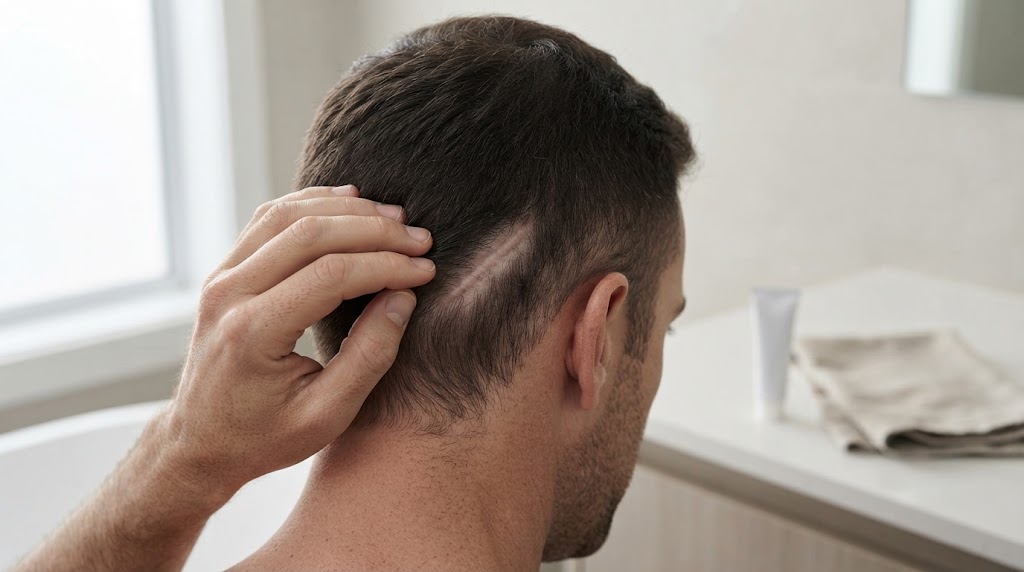
I recommend treating SMP on scar tissue with extra care because scars absorb and retain pigment less evenly. Keep the scalp completely dry for four days, avoid picking, begin gentle washing around day five, avoid direct sun for ten days, and avoid pools, saunas and heavy sweating for 28 days. Full healing takes around 30 days.
You’ve had SMP applied over a scar, whether from a hair transplant, an old injury, or surgery, and now you’re wondering if the healing rules are actually different from standard scalp micropigmentation. They are. Scar tissue behaves unlike the rest of your scalp during healing, and getting aftercare wrong here is more likely to cost you pigment.
Scar tissue lacks the normal blood supply and follicular structure of healthy scalp skin, which means it absorbs and retains pigment less evenly during the healing process. In my 42 years working in this industry, I’ve seen scarred areas fade faster and more patchily than surrounding skin when clients treat aftercare as an afterthought. The seven rules below are the ones I give every client who’s had scar camouflage work done, and they matter more here than on any other part of the scalp.
1. Treat the scarred area as the most fragile part of your scalp
Scar tissue is thinner in places and thicker in others, often within the same patch of skin. That unevenness means pigment sits at slightly different depths across the scar, which is exactly why the healing window needs more discipline, not less.
For the first four days, no water touches the scalp at all: no shampoo, no sweating, no shaving. This isn’t a suggestion for scarred skin; it’s the difference between an even result and a patchy one six months down the line.
2. Expect more visible scabbing or dryness in the healed scar
Scar tissue often flakes more than surrounding skin during days five to ten of healing. This is normal and doesn’t mean the pigment has failed, but it does mean you need to resist picking or scratching, which pulls pigment out unevenly.
Gentle washing can begin around day five, using lukewarm water and patting the scalp dry rather than rubbing. If a scarred patch looks drier or scalier than the rest of your scalp during this window, that’s typical, not a warning sign.
3. Protect the area from sun exposure for longer than you think necessary
Sun is the single biggest threat to pigment longevity anywhere on the scalp, but scar tissue is especially vulnerable because it often has less natural melanin protection than surrounding skin. UV exposure breaks down pigment particles sitting in the dermis and accelerates fading.
Avoid direct sun entirely for the first ten days, then apply SPF 30 to 50 every single day once the scalp is fully healed at the 30-day mark. This isn’t a seasonal habit; it’s a permanent part of protecting the work, particularly over scar tissue where fading tends to show up as patchiness rather than an even lightening.
4. Watch for uneven fading rather than expecting a uniform result
Because scar tissue heals unpredictably, it’s common for pigment to fade slightly faster in the scarred zone than in the surrounding SMP work. This isn’t a sign of a poor procedure; it’s a known characteristic of working with disrupted skin.
A practitioner experienced in scar camouflage builds this into the plan from the start, often depositing pigment in layers across sessions so the final density holds up evenly even if the scar tissue underneath behaves differently. If you notice a scar patch looking lighter than the rest of your scalp at the three or six month mark, that’s worth mentioning at your next check-in rather than something to worry about.
5. Keep every one of your three sessions, even if the scar looks covered after two
Every SMP client requires three sessions regardless of how mild or advanced their hair loss is, and this matters even more over scar tissue. The first session lays foundation dots at lower density, the second builds it up, and the third refines tone, blending and any patchy absorption the scar has shown during healing.
Skipping the third session on a scar is the most common reason clients come back within a year wanting corrective work. The scar needs that final pass to match density with the surrounding hairline and scalp.
6. Avoid swimming pools, saunas and heavy sweating for the full 28 days
Chlorinated water, steam and excessive sweat all interfere with how pigment settles into the dermis, and scar tissue is more sensitive to this disruption because it’s already working with compromised skin structure. Avoid pools entirely for 28 days after your final session, and hold off on saunas or high-intensity training that causes heavy sweating during the same window.
Full healing takes around 30 days. Rushing back into the gym or the pool at week two is one of the more avoidable ways clients lose density on scarred areas specifically.
7. Plan for touch-ups every four to six years, not longer
SMP over scar tissue typically needs touch-up work on a similar cycle to standard SMP, roughly every four to six years, though I’ve found scarred areas can sometimes need attention slightly sooner if the scar sits somewhere exposed to regular friction or sun, such as near a hairline.
Budgeting for this touch-up cycle from the outset, rather than treating the first result as a one-off, is what keeps scar camouflage looking sharp for years rather than fading unevenly and becoming obvious again.
Scar tissue asks more of both the practitioner and the client during aftercare, but the payoff is worth it. Clients who follow these seven rules closely see camouflage results that hold up just as well as SMP on healthy scalp skin, sometimes better, because they’ve paid closer attention to the healing process from day one.
Frequently Asked Questions
Does SMP aftercare differ for scar tissue compared to normal scalp skin?
Yes. Scar tissue has a disrupted blood supply and uneven skin thickness, so it holds pigment less predictably. Aftercare follows the same basic timeline as standard SMP, but sun protection and monitoring for patchy fading matter more, since scarred skin tends to fade unevenly rather than uniformly.
How long does SMP take to heal on scar tissue?
Full healing takes around 30 days, the same as standard SMP. Expect no water on the scalp for the first four days, gentle washing from day five, and avoidance of sun and swimming pools for 28 days. Scarred areas may flake or look drier than surrounding skin during healing.
Why does SMP fade faster on some scars than others?
Scars vary in thickness, blood supply and melanin content, all of which affect how pigment sits in the dermis. Scars with less natural protection, particularly those exposed to sun or friction, tend to fade faster and more unevenly than the surrounding scalp treated with SMP.
How many SMP sessions are needed to camouflage a scar?
Three sessions are required, regardless of the scar’s size or the surrounding hair loss level. The first establishes foundation density, the second builds it up, and the third refines tone and blending, which is particularly important for evening out how scar tissue has absorbed pigment.
Can sun exposure damage SMP results on a scar?
Yes, sun exposure is one of the fastest ways to fade SMP pigment, and scar tissue is often more vulnerable due to lower natural melanin. Daily SPF 30 to 50 once healed, alongside avoiding direct sun for the first ten days after treatment, protects the result long-term.
Ready to talk it through?
Foli Sim in Perth offers a personal consultation to answer your questions and recommend the right approach for you. Get in touch with Foli Sim to book your consultation.