
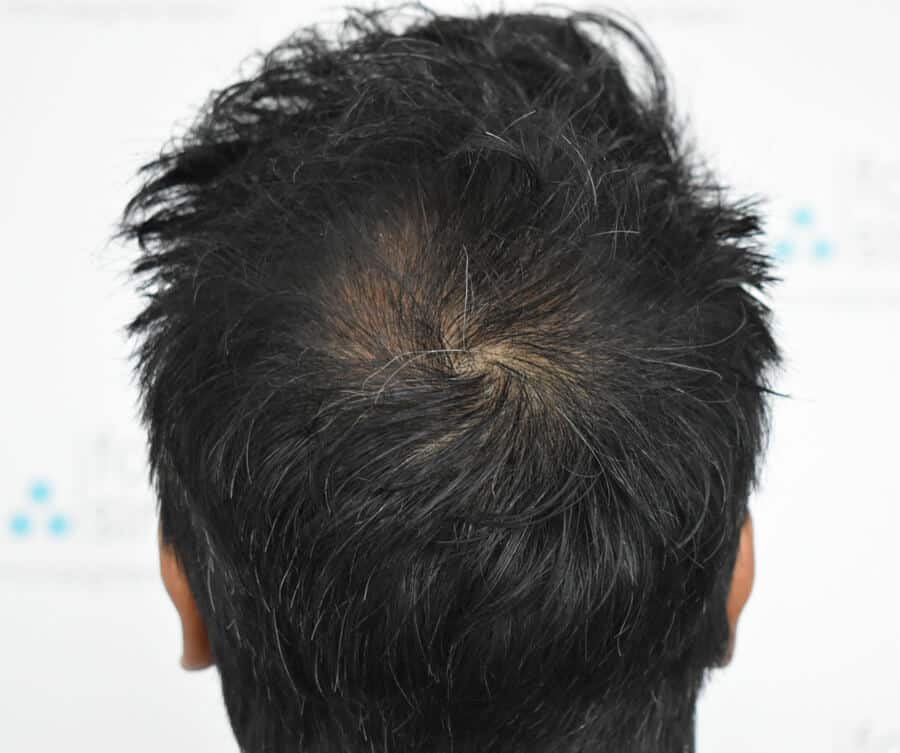
Yes. I plan SMP crown work around existing hair and the way light shows through thinning areas, while hairline work focuses on shape, age-appropriate placement and soft transitions at the front. The two areas can be treated together, but they need different design decisions to look natural.
Why are the crown and hairline treated differently?
When I assess scalp micropigmentation, I look at the pattern rather than treating every area in the same way. A receding hairline is visible from the front and sides, so the design has to create a believable transition into the forehead. A thinning crown is usually judged from above and behind, where light can make the scalp show through the remaining hair.
That means the objectives can differ. At the hairline, I consider its position, the temple shape, the softness of the edge and how it suits your face. At the crown, I consider your existing coverage, the direction of your hair and how much visible scalp is coming through.
These areas often occur together. If so, I plan them as one result rather than creating a strong new hairline and treating the crown as an unrelated patch. The tone, placement and density need to work together when you look in a mirror, under overhead lighting or from behind.
How does SMP for crown thinning work?
SMP crown work can be suitable when you still have workable hair coverage but the scalp is becoming more noticeable. I place pigment between the existing hairs so the contrast is reduced. This is commonly called density work, and it can allow you to keep more length rather than moving straight to a fully shaved style.
The result depends on what remains in the crown. If there is enough hair for the pigment to sit between, the work can support the appearance of greater visual density. When coverage has reduced substantially, adding shading alone may not read as hair. In that situation, I discuss whether a closely cropped appearance would be more coherent.
For SMP crown thinning or SMP vertex thinning, I also take your usual haircut into account. A crown that looks discreet with a matte, dry scalp may look different when the scalp is oily or wet, because reflected light can make the area appear darker. I want you to judge the result in ordinary conditions, not only immediately after treatment.
How is a receding hairline designed?
A hairline is not a straight line that I can place at the same height for everyone. I look at your age, facial proportions, current hairline and the way your recession has developed. The temples matter as much as the centre because an abrupt corner or overly low line can make the result look artificial.
I usually focus on a gradual, irregular-looking edge rather than a hard outline. The design must also make sense with the rest of your hair. If you plan to keep your hair closely clipped, the hairline and surrounding scalp can be treated as a shaved look. If you want to retain length, the plan may instead involve density work through areas where the scalp is visible.
You can read more about how SMP can restore the appearance of a receding hairline, including why the front edge needs individual planning.
Can crown and hairline SMP be done without shaving?
Sometimes. SMP is not limited to a completely shaved head. If your existing hair provides useful coverage, I can plan density work around it, including through the crown, parting or a front that is thinning rather than fully receded. The pigment must be matched to your current haircut and density, so the approach is more precise than simply filling an empty area.
Keeping your hair longer does not make every pattern suitable for density work. The decision depends on how much hair is present, how the area is styled and how visible the scalp remains. I will be direct if a cropped approach is likely to look more consistent over time.
Female clients often present with diffuse thinning, a widening part or reduced density over the crown while keeping their frontal hairline. In those cases, the aim is generally to place pigment between existing hairs rather than create a new shaved hairline. My guide to scalp micropigmentation for women explains that distinction in more detail.
What should I consider before choosing crown SMP?
SMP is long-lasting, but it is not a permanent fixed image. Pigment can soften over the years, and your hair loss pattern may continue to change. I therefore look beyond the area that concerns you today. A treatment plan should make sense with the haircut you are prepared to maintain and with possible future thinning.
I also assess the condition of your scalp and any scars or other changes in the skin. Scar camouflage is a different planning problem from ordinary crown thinning because the surface and colour of scar tissue can affect how the pigment settles. If that is part of your concern, you can read about SMP for scar camouflage.
I am Kate Dawes, Founding Director and Leading Senior Practitioner at Foli Sim, based in the Perth studio. I have worked in the hair industry for 42 years and have delivered SMP results for thousands of Australian clients.
We do not use anaesthetic, and we advise against it. During consultation, I can explain how the procedure is planned for your scalp, your preferred hair length and the difference between crown and hairline work. Prices are published on the Foli Sim website. If Perth is the studio you are considering, see our scalp micropigmentation clinic in Perth.
If you are unsure whether your pattern needs density work, a shaved approach or a combination, booking a consultation is a sensible first step.
Frequently asked questions
Can SMP make a thin crown look completely full?
SMP reduces the visible contrast between your scalp and existing hair, but it does not create growing hair or replace coverage that is no longer there. I assess how much hair remains in the crown before recommending density work. If coverage is too limited, a closely cropped approach may look more natural.
Will crown SMP change how I part my hair?
Not necessarily. If you have enough existing hair, density work can be planned around the way you normally part and style it. However, a very defined part may still expose the scalp under certain lighting. I assess your usual hairstyle during consultation rather than planning only from photographs.
What happens if my crown continues to thin after SMP?
Your future hair loss is part of the planning discussion. SMP softens the contrast in the treated area, but it cannot stop further thinning. If the surrounding hair changes, you may later choose a different haircut, additional work or a revised approach so the overall result remains balanced.
Is a receding crown the same as a bald spot?
No. A receding or thinning crown may still have enough hair for pigment to be placed between existing strands. A bald spot has much less coverage, so the visual result and suitable technique can differ. I assess the area in person, including its size, density, scalp condition and surrounding hair.
Can I treat only the crown and leave my hairline alone?
Yes, that can be appropriate when your hairline is stable and the crown is the main concern. The treated area still needs to blend with your existing hair and overall density. I will also consider whether future changes at the front could affect the balance, even if no hairline work is planned now.